Choosing the right hotel telephones in Australia involves more than selecting a handset for each guest room. Hotel owners and accommodation managers need phones that work with their existing communication systems, provide convenient access to guest services and suit the practical requirements of their property.
From boutique hotels and motels to larger accommodation facilities, guest room telephones remain a useful communication tool. They give guests a direct way to contact reception, request assistance and access hotel services without relying on their personal mobile phones.
With different analogue, SIP and cordless models available, understanding the options can help accommodation providers make informed purchasing decisions.
This guide explains the main types of hospitality telephones, essential features, system compatibility and what to consider before selecting equipment for your property.
Why Hotel Telephones Still Matter in Australian Accommodation
Mobile phones are widely used by travellers, but dedicated hotel room phones continue to serve practical purposes within accommodation properties.
Guests may need to contact reception, request housekeeping, ask about available services or report an issue during their stay. A room telephone provides an established communication point for these interactions.
For accommodation operators, hotel telephones can also support consistent guest service procedures across multiple rooms.
Supporting Guest Communication
A guest room telephone can provide convenient access to:
- Reception and front desk assistance
- Housekeeping requests
- Room service, where available
- Guest information and hotel departments
- Internal room-to-room calling, where supported by the telephone system
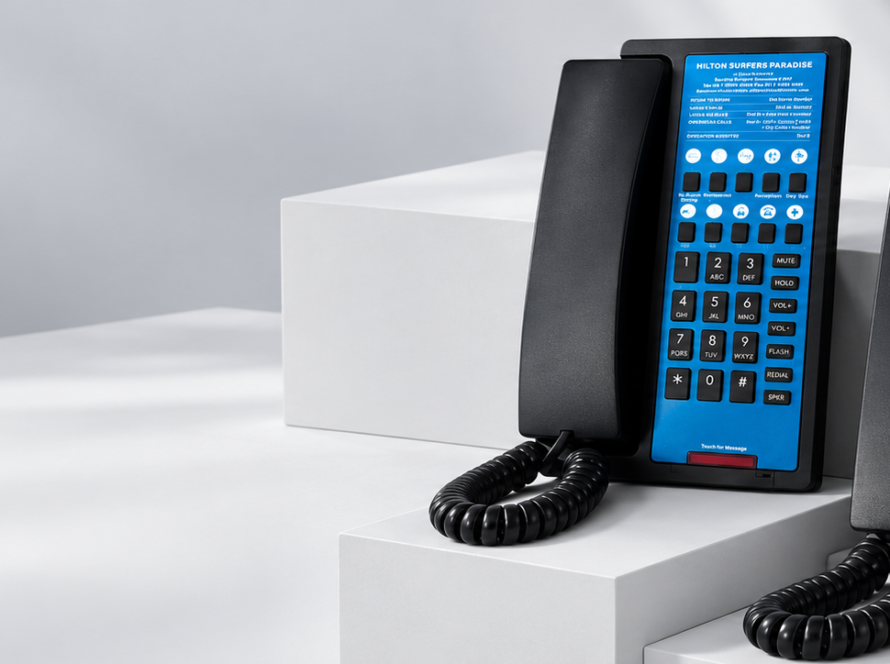
Some hospitality telephones include programmable guest-service buttons, allowing accommodation providers to configure shortcuts for frequently used services.
These functions can make it easier for guests to contact the appropriate department without remembering individual telephone numbers.
Maintaining Consistent Communication Across Rooms
Using suitable telephone equipment throughout a property can help accommodation managers establish a consistent guest experience.
When phones have similar layouts, controls and service buttons, guests can become familiar with their operation more easily.
Standardising compatible models may also simplify staff training, replacement planning and equipment management.
Understanding the Different Types of Hotel Telephones
Before selecting hotel phones in Australia, accommodation operators should understand the main telephone technologies available.
The most appropriate option depends on the property’s existing telephone infrastructure, room requirements and intended functionality.
1. Analogue Hotel Telephones
Analogue hotel telephones are designed to work with compatible analogue telephone connections.
They are often considered by properties with existing analogue telephone infrastructure or compatible private branch exchange (PBX) systems.
Common features available on selected analogue hospitality phones include:
- Programmable guest-service buttons
- Speakerphone functionality
- Message waiting indicators
- Adjustable handset volume
- Desk or wall-mounted configurations
For example, the Bittel UNO PRO Analog Hotel Phone listed by TELDIS includes six programmable guest-service buttons, a speakerphone, adjustable volume and message waiting functionality.
Before purchasing analogue equipment, confirm the connection and signalling requirements of your existing telephone system.
2. SIP and IP Hotel Telephones
SIP hotel phones use Internet Protocol (IP) communications and are designed to operate with compatible SIP-based telephone systems.
SIP stands for Session Initiation Protocol, a signalling protocol used to establish and manage communication sessions over IP networks.
These telephones may be appropriate for accommodation properties operating a compatible IP-based PBX or planning a communications upgrade.
Depending on the model, SIP hotel telephones may support features such as:
- Network-based telephone connectivity
- Programmable guest-service keys
- Speakerphone functionality
- Power over Ethernet (PoE)
- Configuration through supported network systems
PoE allows compatible devices to receive electrical power through an Ethernet connection, subject to the network equipment and device requirements.
The Bittel NEO Analog / SIP Hotel Phone is available in analogue and SIP configurations. Its listed features include single-line or two-line options, guest-service keys and PoE support for the SIP model.
Accommodation operators should confirm the exact model configuration and compatibility with their telephone infrastructure before ordering.
3. Cordless Hotel Telephones
Cordless hotel telephones allow guests to use a wireless handset within the operating range of a compatible base unit.
These models may suit accommodation settings where guests would benefit from additional flexibility when making or receiving calls.
TELDIS lists the Bittel UNO PRO Cordless Hotel Phone, an analogue cordless model with a reversible handset.
Before selecting a cordless option, consider handset placement, charging requirements, available power connections and the layout of the room.
4. DECT and IP Hotel Phones
Digital Enhanced Cordless Telecommunications (DECT) is a wireless communication technology used in compatible cordless telephone systems.
Some hotel telephone systems combine DECT handsets with IP and SIP connectivity.
For example, the Bittel UNOMedia 5 DECT IP Phone listed by TELDIS supports SIP connectivity, PoE and configurations with up to four handsets.
Properties considering this type of equipment should assess the required number of handsets, network compatibility and wireless coverage requirements.
Comparing Hotel Telephone Types
Understanding the differences between telephone technologies can help narrow down suitable options.
| Telephone Type | Main Characteristics | Considerations Before Purchasing |
| Analogue hotel phone | Connects to compatible analogue telephone infrastructure | Existing PBX compatibility, wiring and required functions |
| SIP/IP hotel phone | Uses a compatible IP network and SIP telephone system | Network infrastructure, PBX support and power requirements |
| Cordless hotel phone | Provides wireless handset operation through a compatible base | Handset range, charging and base-unit connections |
| DECT/IP hotel phone | Combines compatible wireless handsets with IP telephone connectivity | Network configuration, supported handsets and wireless coverage |
The best choice depends on the communication infrastructure already installed at your property and the features required in each guest room.
Essential Features to Consider When Choosing Hotel Telephones
Different accommodation properties have different communication requirements. Reviewing the available features can help identify equipment that supports everyday guest interactions and property operations.
Programmable Guest-Service Buttons
Programmable buttons allow hotel operators to assign telephone shortcuts to selected services or departments.
Depending on the system configuration, these may include reception, housekeeping or other internal services.
The Bittel NEO range includes configurations with three, five or ten guest-service keys, while the Bittel UNO PRO Analog model lists six programmable buttons.
Consider how many shortcuts your property requires and how easily guests can identify their functions.
Message Waiting Indicators
A message waiting indicator can notify guests when a message is available through a compatible telephone system.
This function may be useful for accommodation properties that operate guest voicemail or internal messaging services.
Check compatibility between the handset and the property’s telephone system before relying on this feature.
Speakerphone Functionality
A speakerphone allows users to make or receive calls without continuously holding the handset.
This may improve convenience for some guest interactions.
Speakerphone availability varies by telephone model and configuration, so confirm the required function during product selection.
Adjustable Volume
Volume controls allow users to adjust listening levels within the telephone’s supported settings.
For hotel operators, this is a practical feature to assess alongside button layout, handset design and ease of use.
The Bittel UNO Mini and UNO PRO Analog models listed by TELDIS both include adjustable volume functionality.
Desk or Wall-Mounted Installation
The available room layout can influence telephone selection.
Desk-mounted configurations may suit bedside tables or writing desks, while wall-mounted models can help accommodate particular furniture layouts.
The Bittel UNO Mini supports desk and wall use, according to its listed specifications.
Check the mounting configuration of the specific model before installation.
How to Choose Hotel Phones That Work With Your Existing System
One of the main considerations when purchasing guest room telephones is system compatibility.
A telephone may have the required physical features but still be unsuitable for the property’s existing communications infrastructure.
Before choosing new equipment, review the following requirements.
Identify Your Current Telephone System
Determine whether your accommodation property operates an analogue PBX, an IP-based PBX or another compatible telephone arrangement.
If the system type is unclear, contact the property’s telecommunications installer or service provider.
This information provides a starting point for identifying suitable analogue or SIP telephone models.
Check Existing Room Connections
Review the telephone connections currently available in guest rooms.
For analogue systems, confirm the relevant telephone sockets and wiring.
For SIP/IP systems, assess the available Ethernet infrastructure, network configuration and any PoE requirements.
Do not assume that a handset can be installed simply because the physical connector appears suitable.
Confirm Feature Compatibility
Some hospitality telephone functions depend on both the handset and the connected telephone system.
For example, message waiting, programmed service shortcuts and other communication functions may require compatible PBX settings or configuration.
Confirm these requirements before placing a bulk order.
Consider Future Equipment Requirements
Accommodation providers planning room renovations, property expansion or telephone infrastructure changes should account for these projects during equipment selection.
Reviewing future requirements can help prevent purchasing equipment that may require replacement during a planned system upgrade.
Choosing Bittel Hotel Telephones for Different Accommodation Needs
TELDIS lists several Bittel hospitality telephone models with different features and configurations.
The following examples illustrate how available products may suit different purchasing requirements.
Bittel NEO for Analogue and SIP Requirements
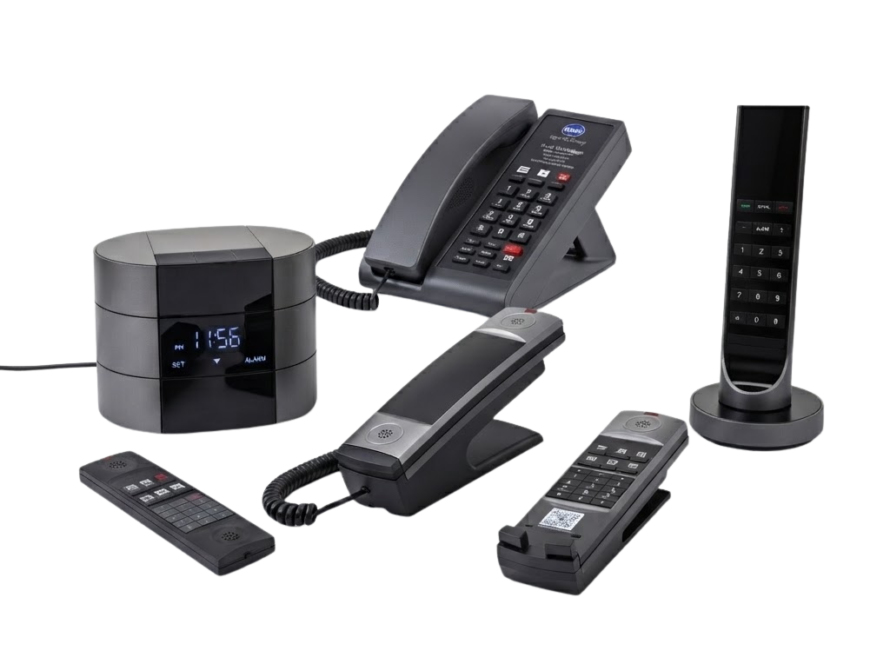
The Bittel NEO range includes analogue and SIP configurations, with options for single-line or two-line operation, speaker or non-speaker versions, guest-service buttons and optional charging.
Its range of configurations makes it relevant for accommodation operators comparing telephone technologies and guest room features.
Review the Bittel NEO Analog / SIP Hotel Phone for listed specifications.
Bittel UNO Mini for Compact Guest Room Layouts
The Bittel UNO Mini is a compact analogue hotel telephone with dual dialpads, programmable guest-service keys, adjustable volume and message waiting functionality.
It also supports desk or wall installation.
Accommodation providers with limited available room space may wish to assess this model against their furniture layout and telephone system requirements.
Bittel UNO PRO for Guest-Service Features
The Bittel UNO PRO Analog Hotel Phone includes six programmable guest-service buttons, a speakerphone, adjustable volume and message waiting functionality.
It may be worth considering where these functions are required and an analogue connection is available.
Bittel UNOMedia 5 DECT IP for Multiple Handsets
The Bittel UNOMedia 5 DECT IP model supports SIP/IP connectivity and configurations with up to four DECT handsets.
This provides an option to assess for accommodation settings requiring multiple compatible wireless handsets.
Confirm the supported system configuration and installation requirements before selecting this model.
You can compare these products and other available options in the TELDIS hotel telephone range.
What Hotel Owners Should Check Before Ordering Telephones
Purchasing hotel telephones for multiple rooms requires planning beyond individual handset specifications.
A structured purchasing process can help reduce compatibility problems and ensure the selected equipment meets operational requirements.
Confirm the Number of Guest Rooms
Determine how many telephones are required across the property.
Include guest rooms and any additional areas that require compatible handsets, such as reception or administration spaces.
Some rooms may need different telephone configurations depending on their intended use.
Review Your Required Features
Prepare a list of essential functions before comparing products.
Consider guest-service keys, speakerphones, message waiting, volume controls, handset configurations and installation options.
Separating essential features from optional functions can simplify product comparisons.
Check Product Specifications
Review the specifications for each shortlisted model, including:
- Telephone connection type
- Compatible telephone infrastructure
- Available power requirements
- Handset and button configuration
- Physical dimensions
- Mounting options
- Supported communication features
For larger purchases, confirming these details with the supplier can help reduce installation issues.
Confirm Availability and Installation Requirements
Before finalising an order, check current product availability, the required model variants and any installation considerations.
TELDIS advises customers to confirm current models, specifications and availability when enquiring about its hotel telephone products.
Common Mistakes to Avoid When Purchasing Hotel Telephones
Some purchasing issues can be avoided through careful planning.
Choosing phones before checking PBX compatibility: Confirming the existing telephone system should be one of the first steps in the selection process.
Assuming every model supports the same features: Guest-service keys, speakerphones, message waiting and cordless operation vary between models.
Overlooking room layout: Telephone dimensions, handset style and mounting options can affect placement and usability.
Ignoring power and network requirements: SIP and IP telephones may require compatible network infrastructure and specific power arrangements.
Ordering without confirming specifications: Product configurations can vary, so confirm the exact model and its required features before purchasing.
Addressing these points early can make the equipment selection process more straightforward.
Choosing Hotel Telephones in Australia With TELDIS
The right hotel telephones should suit your property’s existing communication system, provide the required guest-service functions and fit comfortably within each room.
For accommodation operators comparing analogue, SIP, cordless and DECT options, understanding the available technology and product specifications is the starting point.
TELDIS offers a selection of Bittel hotel telephones, including the NEO, UNO Mini, UNO PRO and UNOMedia models.
Review the hotel telephone products available through TELDIS to compare model options and features.
If you are unsure which telephone type suits your property, contact TELDIS to discuss your requirements, confirm current specifications and enquire about product availability.
Frequently Asked Questions About Hotel Telephones
What type of telephone is used in hotel rooms?
Hotels may use analogue, SIP/IP or cordless telephone systems depending on their communication infrastructure. The appropriate option depends on system compatibility, required features and room configuration.
Can I replace my existing hotel telephones with any Bittel model?
Replacement compatibility depends on the telephone connection, PBX configuration and supported features. Confirm the exact Bittel model and its compatibility before purchasing replacement handsets.
What is the difference between analogue and SIP hotel telephones?
Analogue hotel telephones connect to compatible analogue telephone infrastructure. SIP hotel phones communicate over a compatible IP network using SIP technology. Each type has different system and installation requirements.
Are cordless hotel phones suitable for guest rooms?
Cordless hotel phones can be considered where wireless handset use is desirable. Buyers should assess the base-unit connection, handset range, charging requirements and room layout.
What features should a hotel room phone have?
Useful features may include programmable guest-service buttons, message waiting, speakerphone functionality, adjustable volume and a suitable mounting configuration. The appropriate combination depends on the property’s operating requirements.
Where can I enquire about hotel telephones in Australia?
TELDIS lists a range of Bittel hotel telephone models. Accommodation operators can review the product listings and contact TELDIS to discuss specifications, compatibility and availability.